Professional moisture management in Colorado Springs
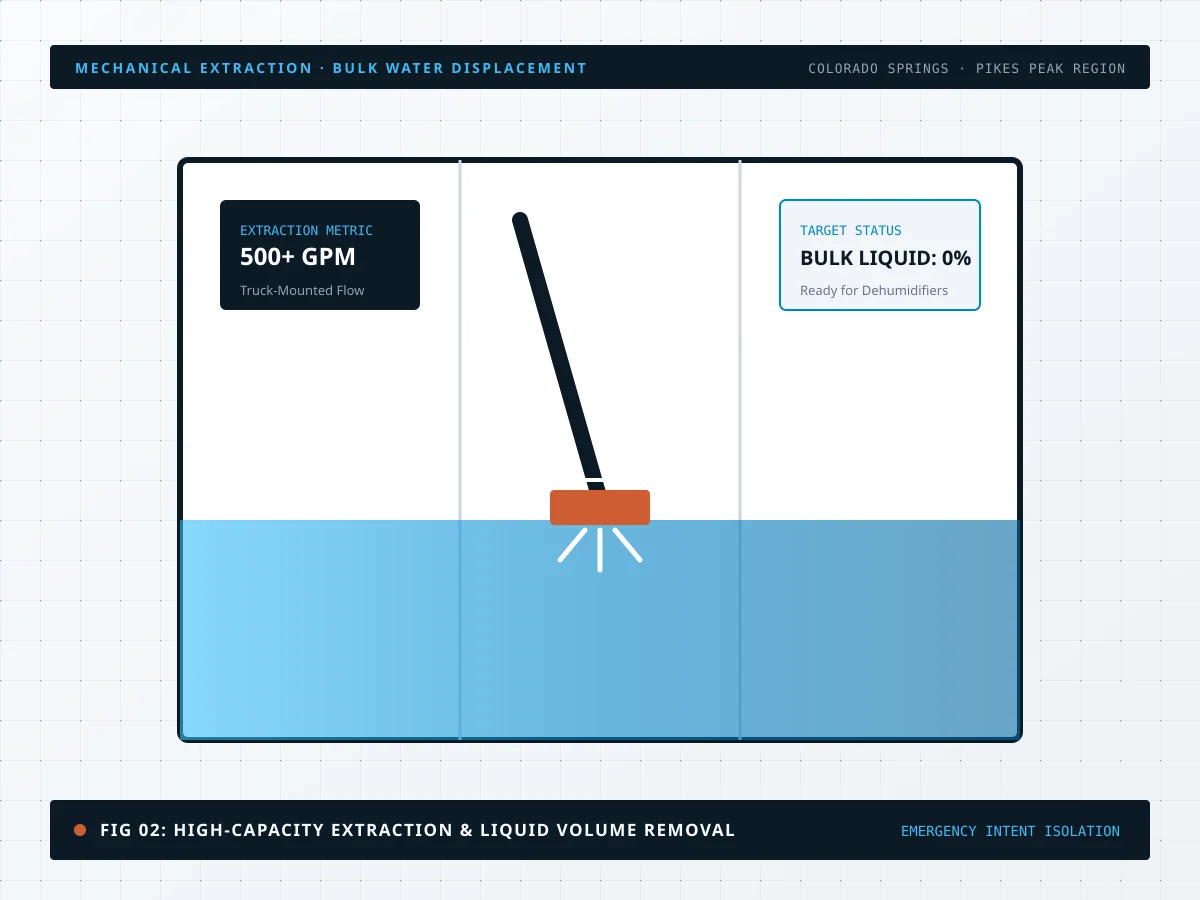
Water removal refers specifically to extracting visible, pooling water using specialized truck-mounted or portable extraction pumps and industrial wet vacuums. In Colorado Springs, sudden winter cold snaps frequently cause supply lines or frozen water meters to burst, flooding basements, mechanical rooms, and crawl spaces. Extracting standing water quickly minimizes water migration into wood framing, insulation, and foundational framing.
The source of the water dictates safe handling procedures. Clean water from an indoor supply line behaves differently than outdoor storm runoff or water that has washed across concrete pads. Importantly, physical extraction removes liquid volume, but it does not completely dry moisture trapped inside building materials. Structural drying and dehumidification must follow extraction to bring humidity levels back to safe baselines.
If your standing water was caused by a broken or ruptured pipe, remember that pipe repair and water cleanup are two distinct services. Colorado Springs Utilities recommends immediately locating and shutting off your main indoor shutoff valve to stop the source. Contact a licensed plumbing professional to repair the mechanical pipe, and connect with an independent water restoration provider to extract standing water and begin structural mitigation.
Essential Safety Measures Before Extraction
Never walk through standing water if electrical outlets, cords, baseboard heaters, or electrical appliances are submerged. Shut off the electrical circuit breaker for the flooded area only if the breaker panel can be accessed safely without stepping in water. If you are unsure, leave the property and contact Colorado Springs Utilities or emergency personnel.
Do not attempt to remove large volumes of standing water with household household vacuum cleaners, which present severe electrocution hazards. Document visible damage with photos and video from a dry, safe position before any extraction begins for your insurance documentation.
Step-by-step restoration and drying approach
1. Stop the Water Flow
Locate your main water shutoff valve near where the service line enters the foundation. If a pipe has ruptured, shut it off immediately. If the water comes from outdoor storm runoff, inspect site drainage from a safe distance.
2. Professional Physical Extraction
Independent restoration technicians utilize high-powered submersible pumps and weighted extraction tools to pull water from carpets, hardwood, and concrete subfloors without causing unnecessary abrasive damage.
3. Moisture Mapping & Containment
After standing liquid is pumped out, technicians use thermal imaging and non-invasive moisture meters to map moisture paths behind baseboards and inside wall cavities, determining the drying perimeter.
Frequently asked questions
How quickly should standing water be removed from a home?
Water extraction should begin as soon as the water source has been stopped and electrical safety is verified. Porous materials like drywall and carpet padding begin swelling within hours, and the EPA notes that mold can begin colonizing damp organic materials within 24 to 48 hours.
Does Springs Water Damage repair broken plumbing pipes?
No. Springs Water Damage is an independent referral service, not a plumbing contractor or restoration company. We connect callers with independent restoration providers specializing in water extraction and drying. Broken pipe repair must be handled by a licensed plumber.
Can water be extracted from a dirt crawl space?
Yes, restoration providers frequently use specialized sump pumps and extraction wands designed for confined crawl spaces. Ask the provider during initial intake about their specific confined-space equipment and vapor barrier inspection procedures.